Dear Explorers, Greetings!
To enrich the strategic choices of Explorers, we plan to make adjustments to the ship production mechanism, equipment carrying, and enhancement mechanism in the near future. At the same time, we will adjust the ways to obtain equipment and technical blueprints to provide more flexible strategic options. Here are the specific details of this preview.
Adjustments to Ship Production and Facility Upgrade Mechanisms
We have separated the blueprint version number and the time and resource bonuses brought by the new system from the calculation method and set them as fixed values. We hope that Explorers will need fixed strategic investments when using ships. This fixed investment maintains a strategic balance among Explorers, bringing more strategic variations to the game.
At the same time, to minimize the impact on Explorers' current gameplay, we have lowered the coefficient of blueprint version number on ship production time/resource bonuses, keeping this strategic investment within a fixed range. Explorers' production time and resource consumption will not be significantly affected before and after the adjustment.
The following are the theoretical values of production time and resource consumption for each ship after investing 50 and 100 Tech Points before and after the adjustment:
Tap here to view the detailed ship build time consumption and required resource changes>>
The detailed adjustments are as follows:
1. Adjustment to the coefficients of blueprint version number and new weapon system on ship production time/resources
The following effects are applied for every increase of 0.01 in the version number of a ship's sub-blueprint:
For Utility Ships, increases the HP by 20, but keeps their resource cost increase unchanged at 0.1%.
For Fighters, increases the HP by 1, reduces their production time increase from 0.5% to 0.3%, and increases their resource cost increase from 0% to 0.1%.
For Corvettes, increases the HP by 5, reduces their production time increase from 0.5% to 0.3%, and increases their resource cost increase from 0% to 0.1%.
For Frigates, increases the HP by 20, reduces their production time increase from 0.5% to 0.25%, and increases their resource cost increase from 0% to 0.1%.
For Destroyers, increases the HP by 40, reduces their production time increase from 0.5% to 0.25%, and increases their resource cost increase from 0% to 0.1%.
For Cruisers, increases the HP by 60, reduces their production time increase from 0.2% to 0.15%, and increases their resource cost increase from 0% to 0.1%.
For Battlecruisers, Auxiliary Ships, and Carriers, increases the HP of the corresponding system by 50 and the corresponding production time increase from 0% to 0.03%.
Blueprint Design - Added a new weapon system and reduces the production time increase from 10% to 5%.
2. Adjustment to the calculation method for ship production time and production resource consumption
Production time before adjustment:
Final ship production time = (original ship production time + time increase from blueprint version number) x influencing parameters
The influencing parameters come from shipyard facilities, expanse docking points, equipment, and more.
Production time after adjustment:
Final ship production time = original ship production time x influencing parameters + time increase from blueprint version number
Production resource consumption before adjustment:
Final ship production resource consumption = (original ship production resource consumption + resource consumption increase from blueprint version number) x influencing parameters
The influencing parameters come from equipment.
Production resource consumption after adjustment:
Final ship production resource consumption = original ship production resource consumption x influencing parameters + resource consumption increase from blueprint version number
3. Adjustment to the calculation method for facility upgrade time and resource consumption
Facility upgrade time after adjustment:
Facility upgrade time = original facility upgrade time x influencing parameters + additional time from equipment
After adjustment, the additional upgrade time from some of the equipment will be calculated independently.
Facility upgrade resource consumption after adjustment:
Facility upgrade resource consumption = original facility upgrade resource consumption x influencing parameters + additional resource consumption from equipment
After adjustment, the additional upgrade time from some of the equipment will be calculated independently.
Adjustments to the Equipment Carrying Mechanism
1. Removal of the loading limit for the same type of Core Interface equipment
Before adjustment
Core Interface Effect: Non-stackable.
Technical Parameter Effect: Stackable.
After adjustment
Core Interface Effect: Partially stackable.
Technical Parameter Effect: Stackable.
Non-stackable effects are as follows: Base Defense: Aggressive Loss and Base Defense: Multi-Target Counterattack.
Non-stackable effects will automatically apply the strongest effect among equipped effects. Regardless of whether the core interface effects are stackable, it will not affect the carrying of equipment. After the adjustment, we hope the activation and carrying methods of equipment will be more flexible, meeting the personal strategic needs of different players.
The following effects have stacking limits: Strategic Reserves.
To maintain strategic balance on the expanse, Explorers can increase the Action Points' storage capacity up to a maximum of 300 points when carrying Strategic Reserves-type equipment.
Adjustments to strategic asset enhancement mechanisms and deployment
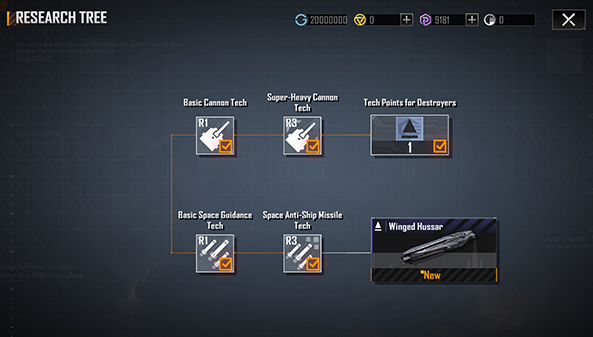
1. Unlocking B-Level Equipment/Technical Blueprint's component upgrade feature
To allow more players to experience the full potential and strategic space of equipment and technical blueprints, we plan to unlock the component upgrade feature for B-Level equipment/technical blueprints. Each B-Level equipment/technical blueprint can obtain up to 20 Component Upgrade Tech Points.
2. Optimization of the Strategic Asset Squad
· We plan to optimize the quality of equipment produced after spending 800 Proxima Coins to assist the Strategic Asset Squad in restoring strategic asset equipment. After the optimization, Players will be able to obtain A-, B-, and C-Level equipment, improving the cost-effectiveness of this acquisition method. We've also optimized the interaction and process for this.
Reopening of the Strategic Assets Technology Achievement Exhibition
To help Explorers better grasp the Technology Assets system, we have made corresponding adjustments to the original Strategic Assets Technology Achievement Exhibition event:
1. Optimization of the event opening time
The Strategic Assets Technology Achievement Exhibition has been well received by Explorers, but the limited selling time has caused many players to miss the purchase window. To ensure fairness for all players, we plan to adjust the event's opening time as follows:
Original opening time: Open for 7 days after first entering the Explorers System. If Explorers don't make the purchase in such a window, it will be permanently unavailable afterward.
Adjusted opening time: Open for 7 days after finishing a star system and entering the Explorers System.
Opening Rules: This exhibition sells 3 types of packages. Each package can only be purchased once permanently.
2. Optimization of the gift pack's content
The contents of the Strategic Partnership Equipment Pack have been adjusted from 1 B-Level equipment to an Explorer set containing 3 C-Level equipment. The detailed adjustments are as follows:
Original B-Level Equipment:
Standard - Ship Production Coordination Controller - Type B5
Main Effect: Increases the queue limit by 1 when the Base shipyard is building ships belonging to Antonios. Affix 1: Increases Repair Speed of Cruisers by 10%. Affix 2: Increases the Resource Trade exchange ratio of the Base by 0.08%.
The 3 C-Level Equipment after the change:
Generic C6 Advanced Military Operation Center
Primary Affix: Increases the number of usable operations by 1.
Affix 1: Increases the Crystal yield of Base facilities by 15%.
Generic C8 Arbiter Planning Center
Primary Affix: Increases the storage limit of Action Points by 20.
Affix 1: Provides an additional hourly Metal production yield of 5000.
Generic - Large Outpost Control Core - Type C10
Primary Affix: Unlocks the construction of Large Outposts (Operation Area 2x2)
Affix 1: Increases the Deuterium yield of Base facilities by 12%.
After the update, all commanders will be able to repurchase this pack once.
For the aforementioned Strategic Partnership Equipment Pack, we also offer a trial feature. Commanders can receive a limited-time trial version of the pack's equipment at the Strategic Assets Technology Exhibition, which lasts for 14 days.
After the trial period ends, the commander can freely choose whether to purchase it permanently and continue using it.
The above changes are expected to be gradually applied in subsequent updates. This concludes our preview. Please accept our gratitude for your continued attention and support for Infinite Lagrange. Thank you!
Later in the Galactic War, the star HD232b at the center of the Fire Seeker System had an abnormal emission of high radiation, affecting almost the entire star system. Above 70% of the cities, space stations, buildings, and fleets system-wide received severe damage, so did the protection facilities of the L893 Gate, making the stargate unable to run. The stellar emission phenomenon continues till now, and the entire star system has already been classified as a "Danger Zone." Some factions even closed the relevant nodes connecting to the Fire Seeker System in the Lagrange Network.
In the following decades, this phenomenon occurred and caused widespread devastation in multiple star systems. According to the Report on the Reasons for High Radiation Emission in Some Star Systems and their Network Loss Situation, there are abnormal changes in space warping at the Lagrange points. It may affect the gravity at the core of stars, lead to the high-energy emission from the interior of them irregularly, and thus cause severe damage to the entire star system. This phenomenon is academically called "Space Warping Vibration," also commonly known as "Warping Reverberation."
From the intel we have, there is a set pattern for the abnormal stellar activity. It can be divided into the Rising stage, Peak stage, and Declining stage. The scope of the radiation zone in a star system will change with the intensity of the stellar activity. During their abnormal activity, stars emit lots of high radiation at intervals hindering the operation of cities, space stations, and fleets. Some of the planets can block stellar jets so that the areas behind them are not susceptible to the high-energy emission from stars. You can take these areas as your security zones.
The Antonios Consortium was also affected by the disaster. Some of the star systems run by them have already begun to have "Space Warping Vibration." Radiation of high levels is emitted at irregular intervals, affecting the star system environment. The consortium's management decided to transfer the valuable assets out of these star systems, including large amounts of experiment data, as soon as possible. Therefore, the Data Rescue Agreement has been issued to recruit experienced explorers to rescue experiment data from these star systems fulls of dangers.
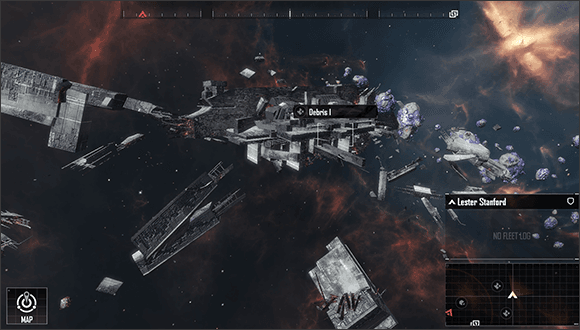
As the buildings in different star systems will become ruins after being continuously damaged by high radiation jets, it is necessary to rescue and migrate the important data stored in the Experimental Center and the Observation Station as soon as possible. Once the space station turns to ruins, it will no longer be able to house and support the crew as it used to. However, there will still be lot of resources, repairable shipwrecks and important experimental data to be recovered by explorers. These undiscovered data in the ruins are the focus of all forces in the star systems in their hunt.
The "Project Garden" planetary ecological transformation experimental program led by the Antonios Consortium has been carried out in five phases on hundreds of star systems, but some star systems are difficult to survive due to abnormal Stellar Activities that lead to the deterioration of the galactic environment. Most areas of those star systems have been abandoned, and many important data were buried in the ruins. \nThe goal of this agreement is to rescue planetary experiments and observation data from deserted star systems that were affected by the "warping reverberation".
As more and more star systems began to build Lagrange Gates in the same way (launch a large number of beacons for testing the safety and pressure of passing the nodes), such a scene appeared in star systems one after another. In the heat of developing Lagrange Nodes, the "Beacon Festival" began to spread to every corner of the galaxy.
"Twinkle twinkle little star, how I wonder what you are?"
—A popular lullaby in Terran Sphere
During the beacon test phase of the "Otherworld Project", beacons were continuously launched into space. These beacons traveled through the under-studied Lagrange Nodes to explore and record star systems on the other side, collecting a lot of valuable data and information for exit positioning experiments. After decades of full preparation, at the beginning of the Phase II implementation, 2,347,260 huge beacons with long life were continuously launched into the channel to test the stability and pressure capacity of the channel. Seen from the ground, these huge beacons formed streaks of light in the sky that kept shining for a whole year. So the people on earth gave them a poetic name: Wishful Lights.


Privacy Policy, Terms and Conditions
©1997-2024 NetEase, Inc.All Rights Reserved
Contact Us: lagrange@global.netease.com
Privacy Policy, Refund Policy


