New features and adjustments for all the star systems:
1. The Twin Festival event is available now:
From the arrival of the first expeditionary fleet at Proxima b, through the return of the Geomar and her exploration group to Earth, to the completion of the L001A and L001B bi-directional gates, this pair of Earth/Centauri "Twinning" evolved from a spiritual concept into a political and economic cosmic entity over the course of hundreds of years, and the Twin Festival was thus established and is still celebrated today.
During the Twin Festival, a series of events will be held in all the star systems to celebrate it.
Event Duration: 2021/12/22 08:30 UTC - 2022/1/5 00:00 UTC
Available to explorers that have expanded their Base to Zone 2 at least once in any star system
1) Four-Light-Year Journey
During the event, you will experience a 4-light-year journey with warp drives. Set sail from the Garden Planet in the Pioneers System, reach 15 stops en route, and finally, arrive at the destination Aurora.
You can obtain an exclusive emblem reward for undertaking the voyage for the first time. Moreover, you can claim a supply reward of Proxima Coins for each stop you reach. You need to tap to head to the next stop.
2) Gravity Detection Operation
It will simulate on the screen how probes collect gravity data on planets. You need to work out routes by operations to make probes you launch pass observation points.
During the event, a new stage will be unlocked each day. There are 13 stages in total. You can earn Cosmetic Points for each stage you clear for the first time.
3) Voyage Entry
It is the story about Geomar and her exploration group returning to Earth from the Proxima b Space Station, consisting of 7 diary entries written by Geomar on the voyage.
During the event, a new diary entry will be unlocked each day. You can claim a reward of Cosmetic Points for each diary entry you listen to for the first time. An additional reward of Proxima Coins is available after you listen to all the entries.
4) Twin Trade Fair:
During the event, you can use Proxima Coins to exchange for special tech files in limited numbers.
2. Combat Mechanism Adjustments:
Adjusted the processing rules for the attack cycle when weapons lose their targets:
After adjustments, when a weapon re-select its target, it will repeat the original attack cycle and enter the preparation stage.
Weapons will stop attacks during target-switching and continue attacking by repeating the original attack cycle after switching targets.
Developer Comment:
A complete attack cycle of weapons includes preparation, firing, and cooling-down stages. At the preparation stage, weapons select targets; at the firing stage, they deal damage to targets; at the cooling-down stage, they stop attacks and make preparations for the next round of firing.
Before adjustments, the loss of targets will trigger the reset of the attack cycle and disrupt the weapons' original attack cycle, making some weapons' combat performance exceed our expectations. After adjustments, the attack cycle of weapons will be as stable as possible.
3. Adjusted the weapon attribute name "Attack Interval" to "Cooldown" on the Blueprint screen.
Developer Comment: "Attack Interval" means the interval between single attacks at a weapon's firing stage; "Cooldown" refers to how long a weapon is at the cooling-down stage. After adjustments, the weapon attribute name will be consistent with the one in the description of system enhancement options.
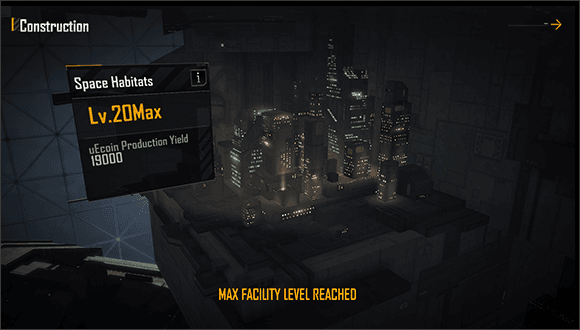
4. Optimized the icon to display Base facilities reaching their max level on the Construction screen.
Adjustments for some star systems:
1. Adjusted the item list at the Black Market in some star systems:
Star systems involved: all the target star systems of the Trojite Crystal Collection Agreement and the Node Recovery Agreement.
In the above star systems, the adjustments on the items sold at the Black Market are as follows:
Replaced the "Black Market Tech Files" with "Black Market Tech Files 2.0;" Replaced the "Ship & Aircraft BP Files" with "Ship & Aircraft BP Files 2.0;" Replaced the "Black Market Tech Files" with buffs/debuffs acquired in the triggered Galactic Event "Interstellar Caravan" with "Black Market Tech Files 2.0;" Replaced the "Black Market Tech Files" yet to be acquired in the Galactic Events and the Dawn Funding Scheme with "Black Market Tech Files 2.0." Adjusted the time of the "Tech Files Selected by Enterprises" available for sale to 72 hours from 120 hours.
Developer Comment: The adjustments can help you better identify where to purchase these items. Their content, acquisition probability, purchase discount, and buffs/debuffs remain the same.
2. Adjusted the way to get some of the blueprints:
Ship blueprints involved:
Mistral - Combat Attacker - Anti-Aircraft Type, CV-T800 - Pulsar Corvette - Anti-Aircraft Type, Quaoar - Railgun Destroyer - Railgun Type, Quaoar - Railgun Destroyer -Torpedo Type, Aldabra - Heavy Cannon Destroyer - Generic Type, Aldabra - Heavy Cannon Destroyer - Armored Type, Jaeger - Heavy Aircraft Cruiser - Auxiliary Type, Jaeger - Heavy Aircraft Cruiser - Anti-Ship Type, Conamara Chaos - Light High-Speed Cruiser - Railgun Type, and Conamara Chaos - Light High-Speed Cruiser - Plasma Type
Before adjustments, the above blueprints are only obtainable in the target star systems of the Trojite Crystal Collection Agreements or the Node Recovery Agreement.
After adjustments, you have a chance to acquire these blueprints from the "Tech Files Selected by Enterprises," "Black Market Tech Files 2.0," and "Ship & Aircraft BP Files 2.0" in any a star system after completing the first phase of exploration.
Later in the Galactic War, the star HD232b at the center of the Fire Seeker System had an abnormal emission of high radiation, affecting almost the entire star system. Above 70% of the cities, space stations, buildings, and fleets system-wide received severe damage, so did the protection facilities of the L893 Gate, making the stargate unable to run. The stellar emission phenomenon continues till now, and the entire star system has already been classified as a "Danger Zone." Some factions even closed the relevant nodes connecting to the Fire Seeker System in the Lagrange Network.
In the following decades, this phenomenon occurred and caused widespread devastation in multiple star systems. According to the Report on the Reasons for High Radiation Emission in Some Star Systems and their Network Loss Situation, there are abnormal changes in space warping at the Lagrange points. It may affect the gravity at the core of stars, lead to the high-energy emission from the interior of them irregularly, and thus cause severe damage to the entire star system. This phenomenon is academically called "Space Warping Vibration," also commonly known as "Warping Reverberation."
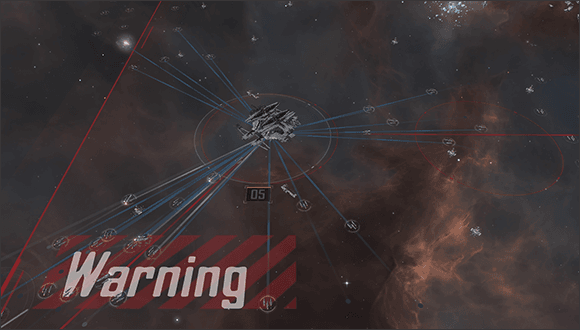
From the intel we have, there is a set pattern for the abnormal stellar activity. It can be divided into the Rising stage, Peak stage, and Declining stage. The scope of the radiation zone in a star system will change with the intensity of the stellar activity. During their abnormal activity, stars emit lots of high radiation at intervals hindering the operation of cities, space stations, and fleets. Some of the planets can block stellar jets so that the areas behind them are not susceptible to the high-energy emission from stars. You can take these areas as your security zones.
The Antonios Consortium was also affected by the disaster. Some of the star systems run by them have already begun to have "Space Warping Vibration." Radiation of high levels is emitted at irregular intervals, affecting the star system environment. The consortium's management decided to transfer the valuable assets out of these star systems, including large amounts of experiment data, as soon as possible. Therefore, the Data Rescue Agreement has been issued to recruit experienced explorers to rescue experiment data from these star systems fulls of dangers.
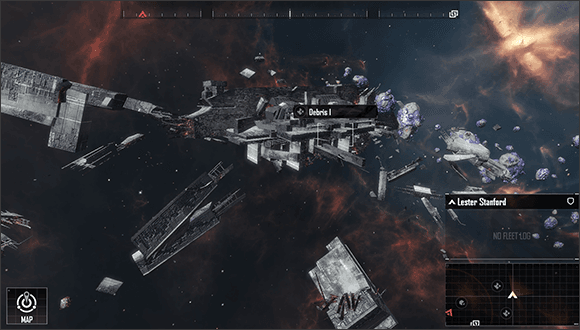
As the buildings in different star systems will become ruins after being continuously damaged by high radiation jets, it is necessary to rescue and migrate the important data stored in the Experimental Center and the Observation Station as soon as possible. Once the space station turns to ruins, it will no longer be able to house and support the crew as it used to. However, there will still be lot of resources, repairable shipwrecks and important experimental data to be recovered by explorers. These undiscovered data in the ruins are the focus of all forces in the star systems in their hunt.
The "Project Garden" planetary ecological transformation experimental program led by the Antonios Consortium has been carried out in five phases on hundreds of star systems, but some star systems are difficult to survive due to abnormal Stellar Activities that lead to the deterioration of the galactic environment. Most areas of those star systems have been abandoned, and many important data were buried in the ruins. \nThe goal of this agreement is to rescue planetary experiments and observation data from deserted star systems that were affected by the "warping reverberation".
As more and more star systems began to build Lagrange Gates in the same way (launch a large number of beacons for testing the safety and pressure of passing the nodes), such a scene appeared in star systems one after another. In the heat of developing Lagrange Nodes, the "Beacon Festival" began to spread to every corner of the galaxy.
"Twinkle twinkle little star, how I wonder what you are?"
—A popular lullaby in Terran Sphere
During the beacon test phase of the "Otherworld Project", beacons were continuously launched into space. These beacons traveled through the under-studied Lagrange Nodes to explore and record star systems on the other side, collecting a lot of valuable data and information for exit positioning experiments. After decades of full preparation, at the beginning of the Phase II implementation, 2,347,260 huge beacons with long life were continuously launched into the channel to test the stability and pressure capacity of the channel. Seen from the ground, these huge beacons formed streaks of light in the sky that kept shining for a whole year. So the people on earth gave them a poetic name: Wishful Lights.


Privacy Policy, Terms and Conditions
©1997-2024 NetEase, Inc.All Rights Reserved
Contact Us: lagrange@global.netease.com
Privacy Policy, Refund Policy


